Profile
History v2
The demonstration of ether use by William Thomas Green Morton for anesthesia in neck excision surgery on October 16, 1846, at Massachusetts General Hospital is considered the beginning of the development of anesthesia. Although four years earlier, W. E. Clarke from Rochester and Crawford Long from Georgia had used ether for anesthesia, neither of them published their findings.
The use of ether for anesthesia spread to England, leading to the publication of the first book on anesthesia in 1847, titled On the Inhalation of Ether in Surgical Operations, written by John Snow, followed by his second book, On Chloroform and Other Anaesthetics, in 1858. John Snow was the first English doctor to study anesthesia in depth. The SpAn doctors’ organization was founded under the name London Society of Anaesthetists in 1858, then expanded to become The Association of Anaesthetists of Great Britain and Ireland in 1932.
To measure a person’s ability to perform anesthesia, an examination is conducted. The first anesthesia diploma examination was held in 1935. Subsequently, the Faculty of Anaesthetists of the Royal College of Surgeons of England was established in 1947. Technical skills accompanied by academic recognition in the field of anesthesia were not always followed by appropriate financial rewards. Official recognition of SpAn doctors as equal to other specialists by the National Health Services only occurred in 1948.
In the past, only a few doctors in America specialized in anesthesia. Generally, doctors were more interested in other fields, and anesthesia was delegated to operating room staff or medical students. Therefore, the Mayo Clinic and Cleveland Clinic trained nurses as anesthetists.
A new organization of anesthesiologists was formed in 1905 under the name Long Island Society of Anesthetists, which was renamed the New York Society of Anesthetists in 1911. In 1936, it was renamed again to the American Society of Anesthetists, and in 1945, it was changed once more to the American Society of Anesthesiologists (ASA).
Thomas D. Buchanan from New York Medical College became the first professor of anesthesiology in 1904. The American Board of Anesthesiology was formed in 1937 and merged with the American Society of Surgery in 1938. Recognition of the American Board of Anesthesiology as an independent body on par with other specialists was achieved in 1941. Since 2000, the American Board of Anesthesiology has required certification for anesthesiologists. Every ten years, the certificate must be renewed by completing a specified program.
Anesthesia equipment was initially very simple. Anesthesia was administered by covering the patient’s nose with a handkerchief soaked in chloroform or by covering the patient’s nose with a towel soaked in ether, which was uncomfortable for the patient. Today, various drugs and equipment have been developed.
Anesthesia equipment was initially very simple. Anesthesia was administered by covering the patient’s nose with a handkerchief dripped with chloroform or covering the patient’s nose with a towel moistened with ether, which was uncomfortable for the patient. Nowadays, various types of drugs and equipment have been developed to make patients more comfortable and safer, as they are equipped with measuring devices, safety devices, and alarms. Additionally, various monitoring devices have been developed that can be used to periodically detect the patient’s physical condition.
The development of anesthesia techniques was not limited to inhalation alone; other techniques were also discovered and developed. For example, in 1898, August Bier successfully performed spinal anesthesia for surgery on humans, a technique developed by Theodore Tuffier from France. Ferdinand Chatelin and Jean Sicard introduced caudal anesthesia in 1901. In 1908, August Bier introduced the intravenous regional block (Bier Block). Epidural anesthesia was introduced by Fidel Pages in 1921, and this technique was developed by Achillo F. Do Gliotti in 1931, who introduced a method for detecting the epidural space based on the loss of resistance due to negative pressure in the epidural space. John S Lundy (1926) introduced the technique of balanced anesthesia. Brian Sword (1930) introduced the use of CO2 binding. De Castro and Mundeller (1959) described the technique of neuroleptic analgesia.
Anesthesia knowledge continued to spread throughout the world, followed by the establishment of anesthesia education centers, for example in Australia in 1952 and Ireland in 1959. Dr. SpAn also formed organizations in each of their respective countries. The first international congress of SpAn organizations, attended by representatives from 28 countries, was held in 1955 in Scheveningen (Netherlands). At this congress, the WFSA (World Federation Society of Anesthesiology) was formed. The WFSA is a unique organization; SpAn members who are recognized by their countries automatically become members of the WFSA.
In Indonesia, at the beginning of independence, the situation was very concerning, both in terms of human resources, equipment, and medicines. At that time, they generally used Dutch leftovers and were handled by nurses.
It was not until 1952 that Indonesian doctors began to be sent abroad to further their studies in anesthesiology. Dr. Moch. Kelan from FKUI was the first doctor sent to study anesthesiology; he was sent to Minneapolis, USA.
The Indonesian Society of Anesthesiologists was founded on June 7, 1967, under the name Ikatan Ahli Anestesiologi Indonesia (IAAI). The IAAI has a logo and anthem. The logo was created by Dr. Syarif Sudirman, and the anthem was composed by Dr. Syarif Sudirman and Dr. St. Mulyata, with arrangements by Kelly Puspito. The logo and anthem were approved at the 1st IAAI National Conference in Jakarta in 1985. Dr. Syarif Sudirman and Dr. St. Mulyata were anesthesiology residents in Semarang, while Kelly Puspito was an artist in Semarang. The name IAAI was later changed to the Indonesian Association of Anesthesiology Specialists (IDSAI) in 1991, but the logo remained unchanged, with only the words “Indonesian Association of Anesthesiologists” being changed to “Indonesian Association of Anesthesiology Specialists.”
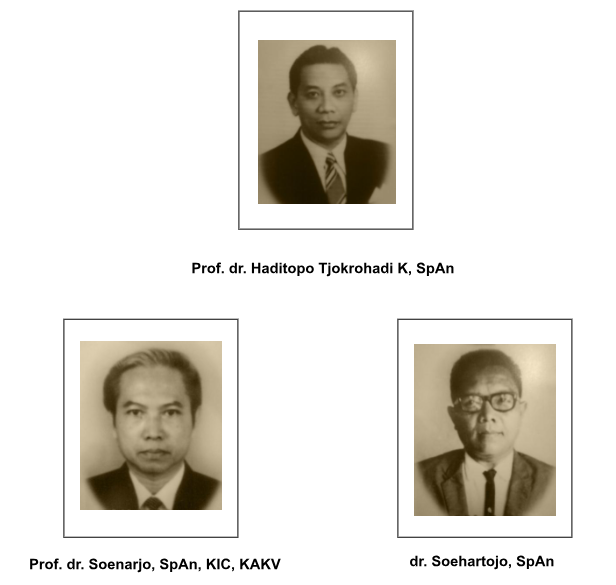
The Anesthesiology Department at the Faculty of Medicine, Diponegoro University/Dr. Kariadi Hospital was founded by Dr. Haditopo Tjokrohadikusumo, who initially served as an assistant surgeon at the Faculty of Medicine, Gadjah Mada University in Yogyakarta. In 1956, a team from the World Health Organization (WHO), including Dr. Rosen Heim and Dr. Wulff, visited and recommended developing anesthesiology by studying in more advanced countries. In 1958, Dr. Haditopo was sent to Copenhagen to study anesthesiology and obtained his anesthesiology specialist degree on
February 16, 1961. After returning to Indonesia, he served in Semarang as the Anesthesiology Coordinator of the Surgery Department at Dr. Kariadi Hospital.
Since 1970, anesthesiology has been officially recognized as an independent branch of medicine. On April 1, 1970, the Department of Anesthesiology was officially established as an independent department, no longer a sub-department of surgery. Dr. Haditopo served as the first Head of Department. Subsequent Department Heads included Dr. Soenarjo (1985–1998), Dr. Marwoto (1998–2004), Dr. Hariyo Satoto (2005–2014), Dr. Heru Dwi Jatmiko (2014–2018), and Dr. Satrio Adi Wicaksono (2019–present). The Anesthesiology Department of the Faculty of Medicine, Diponegoro University / Dr. Kariadi Hospital was strengthened by sending doctors for further study, resulting in Dr. R. Soehartojo obtaining a specialist degree in anesthesiology from the Faculty of Medicine, Diponegoro University in 1972. UI in 1972, followed by Dr. Soenarjo who obtained his degree as an Anesthesiologist & Intensivist from the Institut Voor Anesthesiologie, Faculteit Der Geneeskunde, Katholieke Universiteit, Nijmegen, Netherlands, in 1974.
Although the Faculty of Medicine Undip was established in 1961, specialist medical education in Semarang had already begun through internships with senior specialists. As a result, by 1963, specialists in surgery had been produced, followed by specialists in neurology in 1967, internal medicine in 1968, and obstetrics in 1969. At that time, there were no established regulations or procedures for specialist medical education in Indonesia.
Since 1970, specialist medical education has been more organized in terms of both admission and curriculum. The curriculum is regulated by the Head of Department, who is directly affiliated with the Association of Medical Specialists (Profession).
Until 1978, the number of specialist graduates in Indonesia was still very small, so it was necessary to regulate their supply and distribution. To that end, a joint decree was issued by the Minister of Health, the Minister of Education and Culture, and the Minister of Home Affairs. Subsequently, the Minister of Education and Culture issued Regulation No. 024/DJ/Kep/1979. Based on this regulation, specialist medical education, which was previously handled by professional organizations, became the responsibility of the Ministry of Education and Culture.
Officially, the education of Anesthesiology Specialists in Semarang began in 1974, with Dr. Haditopo, Dr. R. Suhartojo, and Dr. Soenarjo as the pioneers of anesthesiology specialist education in Semarang. At that time, the education of Anesthesiology Specialists was still regulated by the Professional Organization (Indonesian Anesthesiology Association). The Head of the Study Program was held by Dr. Soenarjo (1978–1994 and 1998–2004), Dr. Marwoto (1995–1998), Dr. Uripno Budiono (2005–2009), Dr. M. Sofyan Harahap (2009–2018), and Dr. Taufik Eko Nugroho (2019–present).
With the issuance of the 1979 Minister of Education and Culture regulation mentioned above, Anesthesiology Specialist education was included in the FK Undip Specialist Doctor Education Program, although the material and curriculum remained unchanged.
The legal basis for Anesthesiology Specialist education at FK. Undip was further strengthened by the appointment of Diponegoro University as a provider of specialist medical education by the Minister of Education and Culture. This was further confirmed by the Rector’s Decree No. 144/SK/PT.09/1980 on the establishment of a specialist medical school comprising
11 study programs, including the anesthesiology specialist medical education program.
At that time, specialist anesthesia training lasted for 8 semesters with a total of 144 credits. Given the urgent need for specialist anesthesiologists and referring to the Minister of Education and Culture Decree No. 56/U/1994 article 7 concerning guidelines for developing higher education curricula and assessing learning outcomes, the workload for Specialist I was at least 36 credits. Mendikbud No. 56/U/1994 article 7 concerning guidelines for the preparation of higher education curricula and learning outcome assessments, which stipulates that the study load for Specialist I is a minimum of 36 credits and a maximum of 56 credits, scheduled between 4 and 10 semesters after the undergraduate program. Therefore, the study load for PPDS.I. anesthesiology was considered too heavy, so during the IDSAI meeting on August 1–3 in Jakarta, an ad hoc committee was formed to revise the curriculum. The result was the 1998 Catalog, which reduced the study period to 7 semesters with a study load of 98-108 credits, because the material required to become an anesthesiology specialist could not be reduced to 50 credits.
Currently, the UNDIP Faculty of Medicine’s specialist education in anesthesiology refers to the 2020 catalog, which is a revision of the 2017 catalog, with a study period of 8 semesters and a load of 123 credits, in accordance with KKI Decision No. 37 of 2015 concerning STANDARDS FOR THE EDUCATION OF SPECIALIST ANESTHESIOLOGISTS AND INTENSIVE CARE PHYSICIANS, and KKI Decision No. 38 of 2015 concerning COMPETENCY STANDARDS FOR SPECIALIST ANESTHESIOLOGISTS AND INTENSIVE CARE PHYSICIANS. By adapting from the 2020 KATI Curriculum, the anesthesiology specialist education program at FK UNDIP is conducted over 8 semesters, with a total of 120 SKS. The number of teaching staff, which was originally only 3 people, has increased with the addition of alumni as teaching staff. The quality has also improved with training and study assignments at more advanced education centers both domestically and abroad.
On October 1, 1979, Dr. Haditopo was appointed as the first Professor of Anesthesiology at the Faculty of Medicine, UNDIP, making him the second professor of anesthesiology in Indonesia. Subsequently, Dr. Soenarjo was also appointed as the second professor of anesthesiology at the Faculty of Medicine, UNDIP, on May 25, 2004.
Dr. Marwoto is a graduate of the anesthesiology program at the Faculty of Medicine, Diponegoro University (FK. UNDIP). He then served in the field of anesthesiology at FK. UNDIP and was appointed as the third professor of anesthesiology at FK. UNDIP on March 3, 2006.
Currently, there are more than 150 graduates of the anesthesiology program at FK. UNDIP spread throughout Indonesia. One of them (Dr. St. Mulyata) became the first professor of anesthesiology at the Faculty of Medicine, UNS in 2005.
The anesthesiology department has greatly supported the progress of Dr. Kariadi Hospital, including with the establishment of the ICU on December 8, 1975, which was inseparable from the support of anesthesiology with Dr. Soenaryo SpAn as the first head of the ICU.
With the support of anesthesiology, it has also been possible to perform kidney transplants, conjoined twin separations, hypophyseal tumor surgeries, posterior fossa surgeries, epilepsy surgeries, moya-moya surgeries, liver transplants, open-heart surgeries, and other complex cases.
The Department of Anesthesiology at the Faculty of Medicine, UNDIP / Dr. Kariadi General Hospital also serves the community through activities such as basic life support courses for the public, dispatching personnel to disaster areas like the tsunami in Aceh and the earthquake in Yogyakarta, mass cleft lip surgeries, cataract surgeries, and other procedures in regional areas.